




Therapist vs Life Coach: Key Differences
What is the core difference between a therapist and a life coach?
Choosing between a therapist and a life coach can feel hard. Both offer support. Both give you a safe place to talk. But they do different work.
This therapist vs life coach guide explains the difference in plain language. If you are comparing a life coach and therapist, start with your main need: healing or change.
A therapist is a licensed mental health pro. They assess and treat mental, emotional, behavior, and relationship problems. A life coach helps you set goals, build habits, make choices, and stay on track. Coaching is not a replacement for mental health care.
The key difference is simple. Therapy helps with distress and symptoms. Coaching helps with progress and action.
The American Psychological Association says therapy is a team effort with a trained pro. It also says state license laws help protect the public by limiting practice to qualified providers.
Therapy focuses on treatment, healing, and mental health

Therapy, sometimes called counseling, is a good fit when pain, symptoms, grief, trauma, or relationship stress get in the way of daily life.
Therapists may be psychologists, social workers, licensed counselors, marriage and family therapists, psychiatrists, or other licensed mental health clinicians. Psychiatrists can also prescribe medicine because they have medical training.
A therapist can help you spot patterns, work through pain, manage anxiety or depression, improve communication, and learn coping skills. Therapy can be short and practical. It can also go deeper over time.
Therapists may use CBT, DBT, EMDR, family therapy, or other methods if they are trained and licensed to use them.
Therapy also has clear rules. Licensed clinicians usually need formal study, supervised hours, exams, continuing education, and legal duties around privacy, records, reports, and what they are allowed to do.
These rules matter because therapy often deals with private health data and hard moments.
Life coaching focuses on goals, action, and accountability

Life coaching services are usually for people who are doing fairly well but want help with one area of life.
That may be career direction, confidence, time use, leadership, change, wellness habits, relationships, or a creative project. A coach may ask strong questions, help you spot blocks, plan steps, and check progress.
Good coaching does not tell you how to live. Clear talk helps turn vague hopes into clear choices.
For example, a coach might help you move from “I want better work-life balance” to a plan that protects two evenings a week, sets team limits, and reviews the results after 30 days.
Coaching is less regulated than therapy. Some coaches have strong training and clear rules. Others have minimal formal preparation.
In health and wellness coaching, the National Board for Health and Wellness Coaching says board-certified coaches work within a set scope and code of ethics. Mayo Clinic says health coaching is a partnership that supports wellness goals.
The main differences at a glance
When comparing life coach vs therapist, the right choice depends less on the title and more on the help you need.
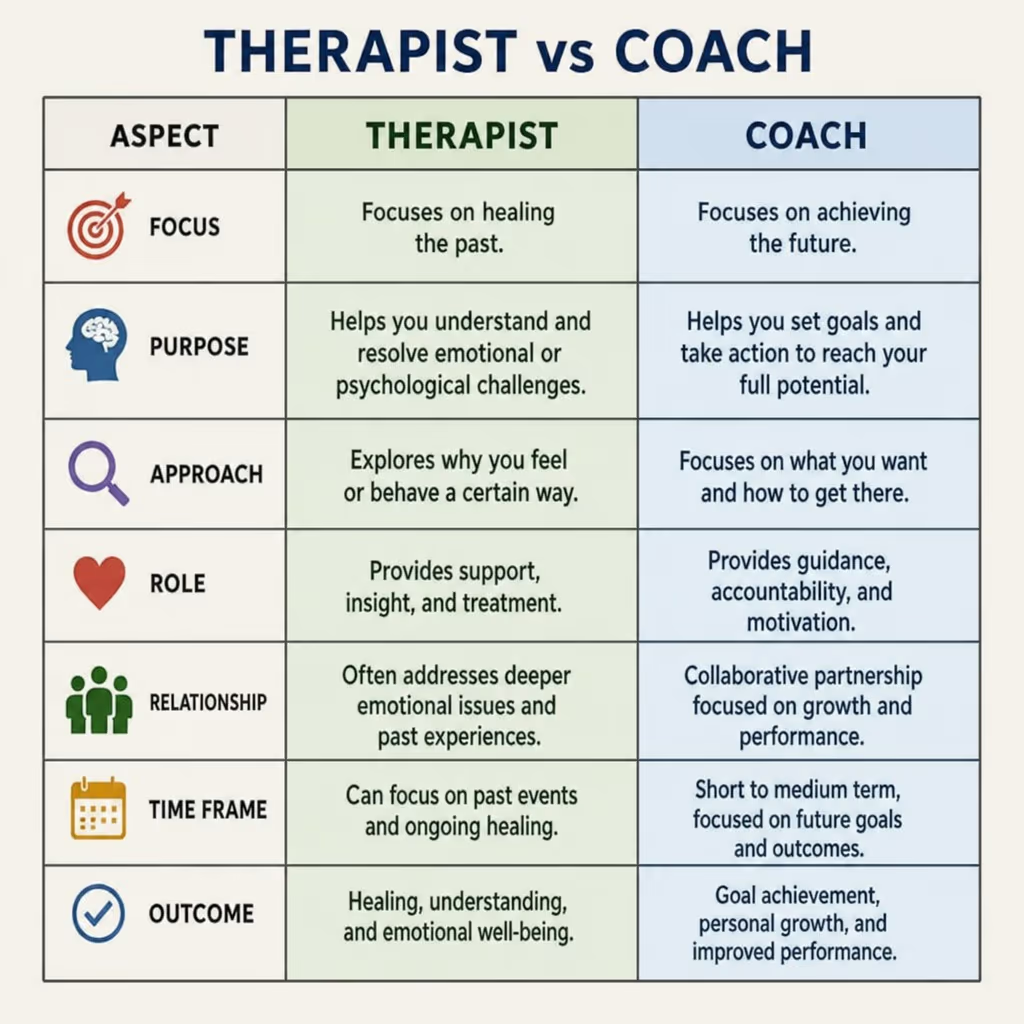
Primary focus
- Therapist: mental health, healing, clinical concerns
- Life coach: goals, growth, habits, accountability
Training
- Therapist: licensed work with set education and supervised practice
- Life coach: training varies; some coaches hold certifications
Scope
- Therapist: can assess and treat mental health conditions
- Life coach: does not diagnose or treat mental health conditions
Methods
- Therapist: therapy methods, clinical checks, treatment plans
- Life coach: goal-setting, reflection, action plans, accountability
Best fit
- Therapist: anxiety, depression, trauma, grief, relationship stress, major emotional strain
- Life coach: career goals, life changes, motivation, organization, confidence-building
Regulation
- Therapist: state boards and professional rules
- Life coach: less uniform standards; rules depend on training and credentials
This is not about which one is better. A skilled therapist and a skilled coach can both help, but they help in different ways.
Problems start when people use coaching to avoid necessary care, or when they expect therapy to function like a productivity plan.
When is therapy the better choice?
Therapy is a good option for strong distress, safety risks, past trauma, daily life symptoms, or unchangeable patterns.
If you experience panic attacks, sadness, self-harm thoughts, or other mental health issues, seek professional help.
Therapy can also help when you know something is wrong but do not know what it is.
A coach may help during a hard season, but coaching should not replace treatment. The National Board for Health and Wellness Coaching says its scope of practice keeps coaching separate from therapy and from care for diagnosed mental health issues, including CBT, EMDR, DBT, and other therapies.
Consider therapy if you notice any of these signs:
- Your emotions feel too big, numb, or hard to manage.
- You are avoiding people, work, school, or duties because of distress.
- You have gone through trauma, abuse, or a major loss that still affects you.
- You are worried about harming yourself or someone else.
- You want help with deep patterns, attachment wounds, or repeat relationship issues.
- You have a diagnosed mental health condition or think one may be present.
If safety is an immediate concern, contact local emergency services or a crisis hotline right away.
Coaching does not provide emergency mental health support.
Coaching is a strong fit for future-focused change
Life coaching can be a good fit when you have a clear goal and want steady structure.
You may not need clinical care. You might need focus, planning, support, and honesty to bridge the gap between your goals and actions.
For example, coaching may help with making a career move, building better routines, improving leadership, handling a non-clinical life change, or finishing a personal project.
In these cases, the coach helps you define success, spot blocks, test strategies, and review what works.
A practical coaching process often includes:
- Clarify the goal. What do you want, and why now?
- See current habits. What helps or blocks the goal?
- Choose small actions. What can you do before the next session?
- Track progress. What changed, what got in the way, and what needs a fix?
- Build ownership. How can you keep going without the coach forever?
This is where life coach counseling can sound confusing. Coaching talks can feel supportive and reflective. But unless the provider is also a licensed therapist, coaching is not clinical counseling.
Can one person be both a coach and a therapist?
Yes. One person can train in both, but the roles must stay separate.
A licensed therapist may also offer coaching, and a coach may later become a therapist. Clients should know which service they are getting, what rules apply, and what the provider can do.
People who search for a life coach therapist often want both action and emotional depth. That can be a good fit if the boundaries are clear.
For instance, if a therapist coaches clients in a different state, legal and ethical aspects might vary. If a coach has training in wellness, business, or education, that does not make them qualified to treat anxiety, depression, trauma, or other mental health issues.
Credentials matter. So does the provider’s willingness to refer you out when your needs are outside their scope.
Before you work with anyone, ask direct questions:
- What license, certification, or training do you have?
- Are you offering therapy, coaching, consulting, or another service?
- What issues are outside your scope?
- How do you handle privacy and records?
- When would you refer a client to a therapist, doctor, or emergency help?
- Have you worked with goals or concerns like mine before?
Clear answers are a good sign. Vague promises, pressure to buy large packages fast, or claims that coaching can cure mental health issues should make you stop.
Therapy, coaching, and health coaching are not the same
The difference between therapy and health coaching matters because wellness goals can overlap with mental health.
Health coaching may support behavior change around sleep, movement, stress management, food habits, or chronic condition self-management in team care. Not the same as therapy, medical care, or nutrition therapy unless the provider also has the right license.
This distinction protects clients. Someone working on sleep habits may benefit from health coaching. But long insomnia tied to trauma, panic, depression, or medicine concerns may need a licensed clinician or medical provider.
A goal to exercise more may fit coaching. Compulsive exercise or signs of disordered eating need clinical care.
Choosing the right support starts with honest self-check

If you are not sure where to start, look at your distress level and the kind of result you want.
Choose therapy when you need healing, diagnosis, treatment, emotional processing, or help with symptoms that affect your life. Choose coaching when you want to move toward a goal and mainly need clarity, structure, and accountability.
You do not have to get it perfect.
Many people start with therapy and later add coaching when they are ready for goal-focused growth. Others start with coaching and move to therapy when deeper concerns arise.
The best support is not the trendiest one. The one that fits your needs, protects your well-being, and helps you move ahead in a safe way.
At Revibe Therapy, we offer both life coaching and clinical care, including EMDR therapy, so you can start with a conversation about what kind of support fits. Serving Winter Park and Orlando / Lake Nona, plus online options across Florida.
Q&A
Question: How do I know if my concern is better for therapy or coaching?
Short answer: Look at your level of distress and the kind of help you need. Therapy is the better fit if symptoms, trauma, grief, anxiety, depression, safety concerns, or relationship stress affect daily life. Coaching is usually better when you are doing fairly well and want help with a goal, habit, career move, life change, or accountability.
Question: Can a life coach help with anxiety or depression?
Short answer: A life coach may help with goals or structure during a hard season, but coaching does not diagnose or treat mental health conditions. If anxiety, depression, panic, self-harm thoughts, substance misuse, eating disorder signs, or trauma symptoms are present, start with a licensed mental health professional.
Question: Why does regulation matter when comparing therapists and life coaches?
Short answer: Regulation matters because therapists handle mental health treatment and private health information under formal legal and professional rules. Licensed clinicians usually need education, supervised practice, exams, continuing education, and privacy rules. Coaching standards are less uniform, so clients should ask about training, credentials, scope, privacy, and referral steps.
Question: Is health coaching the same as therapy?
Short answer: No. Health coaching can support wellness goals such as sleep, movement, stress management, food habits, or chronic condition self-management, but it is not therapy, medical care, or nutrition therapy unless the provider also has the right license. If a wellness issue is linked to trauma, panic, depression, medicine concerns, compulsive exercise, or disordered eating signs, clinical care may be needed.
Question: What should I ask before hiring a therapist, coach, or health coach?
Short answer: Ask what license, certification, or training they have; whether they are offering therapy, coaching, consulting, or another service; what issues are outside their scope; how they handle privacy and records; when they would refer someone to a therapist, doctor, or emergency help; and whether they have experience with goals or concerns like yours. Clear answers are a good sign.
Related from Revibe
- Combining Life Coaching and Hypnotherapy for Growth: how coaching and hypnotherapy work together when behavior change is the goal.
- What Happens in an EMDR Session?: a clear look at clinical trauma and anxiety work when therapy is the better fit.
Services that may help
- Life Coaching: goal-focused support for clarity, habits, and accountability.
- Life Coach Therapist: when you want both action and deeper emotional support with clear boundaries.
- EMDR Therapy: when trauma, stuck memories, or clinical symptoms need licensed care.