

What separates elite athletes from everyone else is their ability to stay mentally controlled when pressure rises. Athletes like Michael Jordan became known for sports stress management, performing calmly, even in situations that overwhelmed others.
Sports psychologists often point to techniques like controlled breathing, visualization, and mental conditioning as key parts of high-level performance. These same principles can help athletes in sports stress management and reduce mental noise.
In this guide, we will break down three simple mental techniques you can use for sports stress management. These are inspired by elite athletes like Michael Jordan, so that you can trust them completely. Also, stay tuned for additional resources.
Why Athletes Need to Learn Sports Stress Management
One of the biggest misunderstandings in sports psychology is confusing stress with anxiety. Sports stress usually comes from trying to manage too many demands at once while still performing well.
However, anxiety is different. It is more future-focused and comes from fear of failure, losing control, and not meeting expectations. According to the ACSM, approximately 30% of female student-athletes and 25% of male student-athletes report experiencing anxiety symptoms.
Another study involving more than 23,000 students found that a large number of athletes report feeling mentally overwhelmed.
Three Sports Stress Management Techniques
To manage pressure, you need to learn how to shift your mental state quickly when it matters most. The following three sports stress management techniques are simple, practical, and based on how elite athletes train their focus under pressure.
Technique #1: The One-Breath Reset

This technique is built around one of the fastest ways to calm the body and sharpen focus, controlled breathing. When stress rises, breathing becomes shallow and fast, which signals the body to stay in a tense state.
Start by taking a slow, deep breath in through the nose. Let the air move down into your stomach rather than your chest. Hold that breath for about three seconds, then exhale slowly through your mouth.
As you exhale, repeat a simple phrase in your mind, such as, “I am steady. I am in control.”
Repeat this three times.
Do it once.
Again.
One last time.
The goal of this technique is to regain control of your attention. This technique works best right before a performance or during moments when you feel overwhelmed.
Technique #2: The Neural Switch

Stress shows up physically before you even realize it mentally. Tight shoulders, a clenched jaw, or stiff hands are signs that your body is holding tension. The neural switch technique helps you redirect that tension and create a consistent trigger for focus.
To use it, gently touch a specific point on your body, such as your ear or wrist, using your dominant hand. While doing this, repeat a short phrase in your mind like, “I am strong, I am focused, I am in control.”
Over time, as you repeat this before practices and competitions, your brain starts associating that physical action with a focused state.
Eventually, the moment you perform that action, your mind shifts automatically into performance mode.
Technique #3: The 3-Second Mental Replay
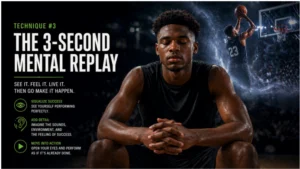
What you picture in your mind before performing has a direct impact on how you perform. If your focus is on doubt or pressure, your body reacts accordingly. Similarly, if your focus is on successful execution, your brain prepares you to follow that pattern.
The 3-second mental replay is about quickly visualizing success before action. Close your eyes for a brief moment and imagine yourself performing perfectly. See the movement clearly, whether it is making a short, crossing a finish line, or completing a list.
Add detail by imagining the sounds, the environment, and how it feels to succeed. After those few seconds, open your eyes and move into action as if that moment has already happened.
This works because the brain responds to vivid mental imagery in a similar way to real-life experiences. By rehearsing success mentally, you prepare your body to follow through physically.
How to Build a Strong Competitive Mindset
One of the biggest parts of building this mindset is learning to separate performance from emotion. Bad moments happen in every sport. Missed shots, mistakes, pressure situations, and setbacks are unavoidable.
What matters is how quickly an athlete resets mentally instead of staying stuck in frustration or self-doubt.
Consistency also matters more than motivation. Motivation changes daily, but routines and mental habits create stability. That is why many elite athletes use the same mental preparation techniques before every performance.
Confidence works the same way. Real confidence comes from repeated preparation and proof that you can handle pressure. Sports psychologists often describe confidence as a trained response rather than a personality trait.
| Ready to Strengthen Your Mental Game?
If stress, overthinking, emotional inconsistency, or performance pressure keeps interfering with your game, you do not have to figure it out alone. Revibe Therapy provides sports psychology coaching and mental performance support designed to help athletes improve focus, confidence, emotional control, and consistency under pressure. Book a consultation and start building habits that strengthen both your mindset and your performance. |
Extra Tools That Support Peak Performance

Mental performance becomes much easier to maintain when athletes support their routines with tools. Your goal should not just be to perform well once, but to create habits that make strong performance more repeatable under pressure.
Here are some free resources that you can use for reaching your peak performance:
1. SCBG System
The Sacrificial & Compensational Behavior Goals (SCBG) System helps athletes structure their day more intentionally. It focuses on compartmentalizing tasks, prioritizing discipline-based activities first, and reducing impulsive behavior.
The system teaches athletes to complete sacrificial activities first: training, studying, recovery work, and responsibilities.
2. Sports Stress Release Hypnosis Audio
Stress often builds subconsciously before athletes even realize it. The Sports Stress Release Hypnosis Audio is designed to help calm mental noise, reduce internal pressure, and help athletes enter a more focused performance state faster.
Many athletes use guided mental conditioning audio as part of their preparation routine before training, sleep, or competition to improve emotional control and focus.
3. Emotional Pattern Chart
Emotional reactions can quietly affect confidence, focus, and decision-making during competition. If you are feeling something similar and want to identify your hidden emotional triggers, then this chart is the best free option.
The Revibe Therapy Emotional Pattern Chart helps athletes recognize emotional shifts before they begin controlling performance. By doing so, you can easily reset yourself mentally and stay emotionally balanced under pressure.
4. Diaphragmatic Breathing Demo Video
Breathing directly affects the nervous system. When athletes become stressed, breathing becomes shallow and rapid, increasing tension and making focus harder to maintain.
This Diaphragmatic Breathing Demo Video provides a step-by-step breakdown of controlled breathing techniques. It will help calm your body, improve focus, and support better emotional regulation during high-pressure moments.
Train Your Mind Like You Train Your Body
The sports stress management techniques we have discussed will help you reduce anxiety if you follow them correctly. Remember, the best athletes are the ones who know how to control their stress response.
However, sometimes, an athlete’s performance is hindered not because of practice but because of a mental block. To overcome this, sports psychology therapy is the best option and is one of our specialized services.
At Revibe Therapy, we offer specialized support for athletes through sports psychology coaching, cognitive hypnotherapy, and more.
Don’t let big stages hold you back; start your therapy today.


 Most often it is not the situation, but how we think about the situation that causes our feelings. How we think about situations is based on what we have learned and experienced in the past. Over time we may begin to react in ways that do not help us, and start feeling stuck and unhappy.
 Dr. Ivey, Psy.D. completed her doctorate in Clinical Psychology with a concentration in Organizational Consulting at Pacific University’s School of Graduate Psychology in Oregon. For her dissertation, Dr. Ivey conducted qualitative research on the effects of workplace discrimination and microaggressions on minority Veterans’ overall job satisfaction with their military career. She completed the APA-accredited Psychology Internship training program and Postdoctoral Residency at the Orlando VA Healthcare System.
 I know you’re stressed and exhausted while trying to keep up with the world’s go go go trials, trying to do it all perfectly. This “hustle” mentality makes all of us prone to mistakes and poor decisions. Your mind is overthinking at such a high pace by now that you no longer know where to find the off button, or recall when you turned it on in the first place. Trust me, I’ve been there, and in that dark place is where you start to feel worried and fearful about the future because you don’t feel in control of the now. Sound familiar?
 Often, when we seek support through therapy, we seem to underestimate the power of our own role in the healing process. We have all carried metaphorical luggage filled with experiences and events that have impacted our life. I know that it has been hard for you to seek support in untangling those moments from the past that now provoke stress, anxiety, frustration, anger, loneliness, sadness, guilt, depression, or hopelessness. The fact that you are reading this means that you have the intention to become the best version of yourself.